You start as the future; then you are the establishment; and then it’s done.
I think, without dwelling too much on it, that is the political life of Nicola Sturgeon. Something that can be overlooked (or that we choose to overlook) in the ‘Sturgeon Story’ is that she is (or at least tried to be) a career politician. She was 21 when she first stood for the SNP in Westminster; sought election to the old Strathclyde Council a number of times. I appreciate that I am in the minority when I say that I don’t think ‘career politicians’ are bad things – politics is a skill and an art, and having someone dedicated to learning it is certainly a fine and fair thing. But it is something that ‘the public’ uses as an insult – but not for Nicola Sturgeon.
She was first elected as a (Glasgow List) MSP when she was younger than I am now – nearly 24 years ago. Then she was the future. A young MSP, part of then-leader Salmond’s’ ‘gradualist wing’, she held a plethora of front bench posts, including education and justice. She gained a more public profile as part of the ‘s.28 Debate’ in the Scottish Parliament. Seeking to advance the rights of LGBT people, but seeking to temper that with safeguards and guidance also. It was something, ultimately, that cause serious divisions in the SNP support – with SNP Mega-donor Brian Souter going as far as to fund a straw poll against it. Even as a straight guy with no self-interest at play who was no older than 8 or 9 at the time – I can still the effect of the s.28 stuff. I remember posters and a strange shouty man standing outside my school warning of immorality being taught in the classrooms. My dad had him removed when he complained to the head teacher.
When Salmond gave way (the first time) it was not yet, her time. Fellow gradualist (but more economically cautious) John Swinney’s victory in 2000 only lasted 1 election cycle. He resigned in 2004 after a string of poor election results in 2003 & 2004 – and created the last competitive SNP Leadership Race. This, it was believed, was Sturgeon’s time. She was the gradualist successor who could build the party back up. Then Deputy-Leader, Roseanna Cunningham didn’t think so and believed – because this was not a settled position even just 20 years ago – that an Independence Referendum was needed for Scotland to leave the UK. An SNP victory was enough. The SNP membership, it appeared, seemed to think that that was the way forward too – and Sturgeon’s support was weaker than that of the more Fundamentalist Cunningham’s.
In order to rescue the project he had been developing – closer now than ever to its goal – and despite having made a full Sherman Statement1 just a month beforehand, Salmond emerged as a last-minute contended for the Leadership with a deal brokered with his soon-to-be protégé Sturgeon – He would save the Leadership, She would serve as his deputy. I can remember, while I was still at school, hearing people – from her party and others – refer to sturgeon as a “Nippy Sweetie”. I didn’t take this to be a particularly misogynistic phrase at the time, since I thought it she was being called a “Nippy Sweety” – like one of those joke sweets that are filled with Chilli Power. Liable to give you a verbal lashing. I genuinely thought it was simply a reflection that she was a bit of a dogged fighter…which may be one of her defining characteristics in future years.
Sturgeon used those 8 years wisely. Not, particularly, looking for a way to climb up the greasy pole, but to study the pole itself. There are noticeable differences between 2004 Sturgeon who needed Salmond to help her, and 2014 Sturgeon, who was ready to assume the mantle of power after he stood down. She may have developed Salmond’s unfortunate snicker, but she used her role as deputy, not as a staging post, but as an apprenticeship. She was close to Salmond. She wasn’t just an ‘also’, but an ‘and’. The run-up to the IndyRef made this clearer than ever – with Sturgeon in charge of the SNP’s Election campaign.
She did have the day job, of course – as Health Secretary. She oversaw the final stages of construction and opening of the QEUH ‘Super Hospital’ in Glasgow and guided the Alcohol (Minimum Pricing) (Scotland) Act 2012 through Parliament, introducing minimum unit costs for off-sales in Scotland after a lengthy private Legal Challenge. She was also, latterly, the Infrastructure Secretary – making a number of major announcements and pledges to great fanfare. Reducing train times between Glasgow and Edinburgh to just 35 minutes, which people would be able to pay for using their new all-areas all-services ‘Saltire Card’ smart ticketing system. Both improvements, have not come to pass – he types, sitting on his train he had to get a paper ticket for.
After losing the IndyRef, Salmond stepped aside – for the second time – and Sturgeon, once again, stepped up. This time, there was no other – there couldn’t be. Nothing, I am sure, quite prepares you to lead a nation – particularly not one as divided as Scotland was as it woke on the 19th September 2014 – but she was certainly the closest to prepared there could be. The Future was Now, and we began to reckon with he effects of IndyRef. Looking back, it might seem weird to think of a time the SNP didn’t just walk Scottish Elections – but everything before this paragraph was that time.
Sure, 45% doesn’t win you a Referendum; but it is fairly unassailable in FPTP General Election. The 2015 UK General Election served to increase not just the number of SNP MPs, but also Sturgeon’s profile across the wider-UK. Some Labour-minded English voters longed for a Sturgeon-esque figure to emerge in the Party if Ed Miliband (remember Ed Miliband!?) were to lose the 2015 election. Which he did. And it would be both unfair and – to ascribe the rise of Corbyn exclusively to Sturgeon’s influence, the appeal of someone…well…appealing, suddenly had a face. And electorally, the success continued. The SNP has been the 1st placed party in every national election it faces while Sturgeon was leader. There have been higher and lower points – but always at the top.
But winning is easy, reader; Governing’s harder.2
Made harder, of course, by the fact that there was a massive pandemic in the middle of it. Sturgeon at the time made many calls. Only she in her own heart will know why she made the calls she made. It may be that she genuinely felt that almost every time the UK Government made a decision, the right decision for the Scottish Government to make was broadly similar but distinguishably different. But she was undoubtedly more reassuring looking than the UK Leadership at the time was. And, indeed, when her Chief Medical Officer took 1 car trip too many, she was out – no minister of hers would live differently from the population at all. This would be a test of her Leadership.
A Leader who asked her leadership to be measured on Education has an educational attainment gap which is at best stagnant and in some places growing. A Leader who previously served as Health secretary faces a recruitment crisis in the NHS, growing waiting lists, a National Care Service with no services, and capacity problems in A&E departments all over the country – including a certain Super-hospital in her home constituency. A Leader who was once a lawyer, facing industrial action from solicitors over legal aid, civil servants over court pay and funding, and an increasingly over-stretched Crown office over an ever-growing backlog. A Leader who launched ferries in 2015 is yet to hit the sea in 2023.
And yet – all the while, the troops have been marched to the top of the Hill. The rock-star appearance at the 2015 SNP Conference may have seemed hubristic but was undoubtedly deserved! The General Election showed that Independence was, certainly, not off the table. 2015 showed it. 2016’s Brexit Referendum showed it. 2017, 2019, 2021 – all made the case for independence. The Mandate was there – but there seemed to be no plan to act on it. Much to the frustration of many.
And then, like falling in love, her resignation happened slowly then all at once.3
There had been signs and concerns, of course. But that was (and is) all hidden behind the fact that, even in the face of a UK-wide resurgence of the Labour Party who hold a 20+ lead in the UK-wide polls, and a slowly steadying Scottish Labour Party with its own charismatic leader – Scotland was still, by some way, Sturgeon’s stomping-ground.
But there were some polls showing a step backwards. Those awkward political questions became a little more common. The polls looked a little less astounding than they had been. There was a police investigation launched, to look into alleged mis-spending of the ‘IndyRef2 fighting Fund’, after complaints by SNP members and supporters. And still – despite assertions to the contrary that she had built “…a majority for independence…” in her goodbye address – Independence still lags behind in the polls, still at that 45/55 split we saw nearly a decade ago.
And, most recently – the Gender Recognition Bill (as it still is). Set aside, if possible, the content of the Bill and focus, instead, on the process. The SNP who usually march in lock-step across both Parliaments – divided on this. The GRA Reform has led to the most unlikely scenarios in Scotland over the past year: Ian Smart gaining the support of Wings; Wings cheering on the Tories; Tories gaining SNP voters who oppose the GRR Reforms; and an SNP front-bencher resigning on policy. Ash Regan’s decision to resign – and the group of very vocally anti-Gender Recognition Reform MSPs and MPs being so very public and confrontational about the Bill in Parliament is the first full-on rebellion that Sturgeon – indeed the SNP – have meaningfully faced in the Scottish Parliament. I would be sad if it was a commitment to progressive reform of legislation is what has brought an end to Sturgeon; but one cannot say that it was not a symptom of her hamartia.
Someone who faced no to little meaningful opposition for the best part of 20 years suddenly faces it – vocally, repeatedly and persistently. And not from her natural foes, but from her thus-far allies. Instead of backing down, she doubles down – she is, after all, a dogged and determined fighter. The decision to ensure the Bill passed the Parliament may have been made because she is a fighter for what she thinks is right; equally it may be noted that Kate Forbes (who is a member of the Free Church of Scotland) is on maternity leave and due to return shortly. It may be that it is on principle that her opponents have seized this opportunity, perhaps, to apply pressure – or it may be that they have noticed the decline in SNP and Pro-Indy polling since the Bill was passed by the Scottish Parliament.
All the while – the troops are sitting, waiting on the top of the hill. They have been told that they cannot call UDI; that a UK-Sanctioned 2014-style ‘Gold Standard’ Referendum is some way off; that a wildcat referendum is not an option; and that a de facto referendum may well end in defeat.
I tell the story above in as much detail as I do for a reason – that, fundamentally, the issues and questions that faced the SNP in 2004 as Sturgeon lost the leadership; in 2014 as she gained it; and 2023 as she relinquishes is are, at their bases just the same. Very little about the challenges the SNP faces have changed – but the circumstances in which it finds itself have. And they have, overwhelmingly, been of Sturgeon’s making.
When the SNP membership is asked, for the first time in nearly 2 decades, to choose its new leader, all the dynamics I mentioned above are all factors in that decision. LGBT rights, the issue which brought Sturgeon at the start of her political career (and may well have had a hand in closing it) remains a very live, though different, issue today – one that continued to play out in schools and civic life, and between SNP supporters. The Fundamentalist/Gradualist question – where the Salmond/Swinney/Salmond/Sturgeon consensus held almost unflinchingly – will actually need to be asked again. If gradualism wins, gradual how? What is a de facto referendum? If a fundamentalist wins, how fundamental? Wildcat Referendum? UDI? What does this mean now? And, unlike in 2007 or 2014 when money flowed and promises were cheap – 2023’s New First Minister will not have that. Spending will be difficult. Choices will have to be made somehow. And, leaving alone what may come in the future – all those problems with teachers/waiting times/trains/the national care services/local government/legal aid/GPs/ ferries that were all issues during Sturgeon’s time in power, are still problems that need facing.
And there is, finally, another factor – there isn’t another Nicola Sturgeon. I have avoided mentioning the Salmond Scandal, the Mark McDonald Scandal, the Bill Walker Scandal, the Derek MacKay Scandal, the Patrick Grady Scandal – mostly because they were (largely) irrelevant to dealing with Sturgeon’s story. But they are relevant here. The only successor to Salmond (the second time) was Sturgeon; in the same way that the only successor to Blair was Brown. There was a time that the answer to the question “Who will succeed Nicola Sturgeon” was obviously “Humza Yousaf”, and then it was obviously “Derek MacKay” – then one was outed as useless and the other outed as creepy. One may be tempted to note that Angus Robertson has been conspicuously absent from the front of the SNP for a while now, and one may speculate that that is a deliberate choice to protect him – and that may well be the case. While I would suspect he is a front-runner for the Leadership, he is not a man without his own baggage.
Since the MacKay scandal, the answer to “Who will success Nicola Sturgeon” has been “That’s not happening”. But now it is, and the party has no clear answer – primarily because it doesn’t know what party it wants (or needs) to be now. Does it need to be more conservative, or more liberal in its thinking? More fundamentalist towards achieving Independence; or not rock the boat? Committed to public spending, or more fiscally austere? Who has the leadership skill and grit to steer the Government through the actual day-to-day business of governing while being a charismatic figurehead for the Independence movement? Does that need to be a ‘career-politician’…or should it be?
It is the moments when a party asks itself “Who do we need to be as a party” that are most dangerous for it, because they can reach the wrong answer. It has happened to Labour (Corbyn) and the Tories (Truss) because the members listened primarily to themselves, and not those they needed to convince. However – that doesn’t need to be the case.
I end on an important note of caution. There is a tendency in my party to assume that Sturgeon going necessitates a decline in SNP support & that a decline in SNP support must mean in rise in Labour support. This is not so. Firstly, the SNP may well answer that “Who do we need to be as a party” question correctly, just as Labour (with Blair) and the Tories (with Cameron) have before. We need to remember that not even Nicola Sturgeon was as popular as Nicola Sturgeon was when she became First Minister. But secondly – and perhaps more importantly – we cannot allow ourselves to believe that voters will come back to us if we sit back and do nothing.
While the SNP have certainly lost their biggest electoral asset, and while I believe that there is no one who can quite replace her – we cannot expect people to abandon the SNP and ‘Come Home to Labour’ just…cos. We must continue to build our offer to the electorate (which I’m sure Anas and Keir will be doing at Scottish Labour conference this weekend) to give them a reason to listen to us. And people are, once again, beginning to listen and maybe – just maybe – with someone at the helm who is less media-savvy, less polished, less exciting, less full-throated, less dynamic and (frankly) less well-known then maybe – just maybe – people will continue to listen.
So while Sturgeon will argue a lot has changed in her time at the top – I would say that, fundamentally, little has shifted. And that might be Labour’s opportunity.
1 “If nominated I’ll decline. If drafted I’ll defer. And if elected I’ll resign.”
2 But to be fair, she was far from Helpless and did not throw away Her Shot.
3 DFTBA.
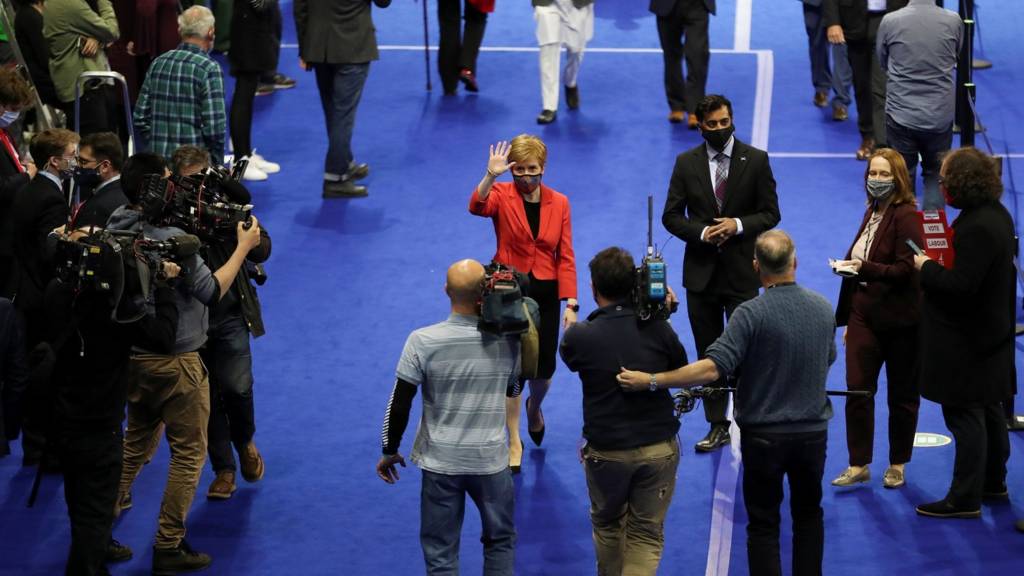
And yes, the header image has been chosen, exclusively, because I am in it – standing to the right with a vote Labour Clipboard. I was maliciously trying to disrupt the shot of Sturgeon entering the Count triumphantly. I am not above such petty fun.
 Paul Cruikshank
One thought on “Who’s like her – damn few…”