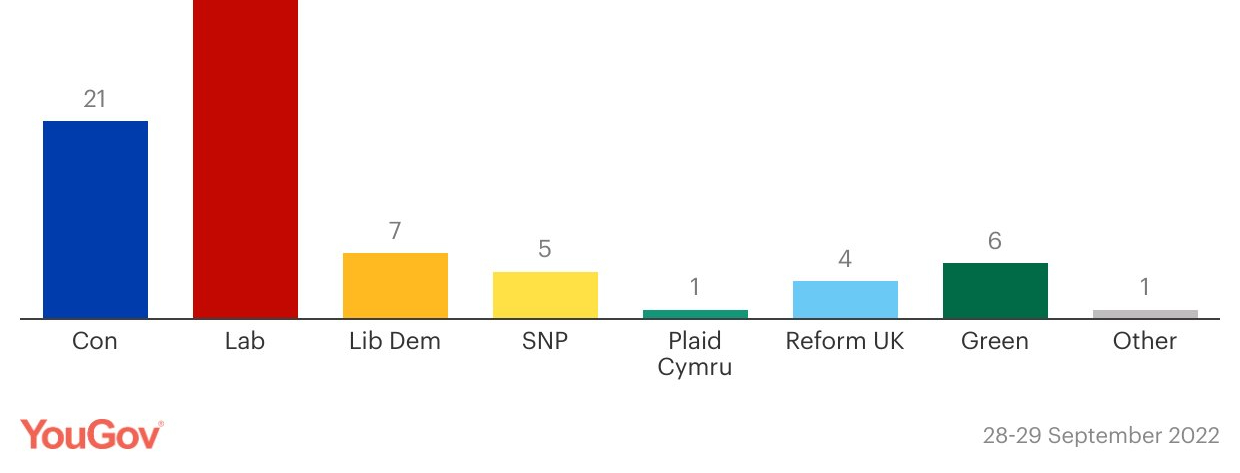
It’s been a good 2 weeks to be a Labour Member and Supporter. Every major pollster has Labour with at least the meme-tastic 20-point-Lead (and some even a stubborn 30). Even in Scotland Labour have now firmly established themselves in 2nd place and as the challenger to the SNP…albeit still 15/16-points adrift.
So this is good – but this could be a Long 2 years. In the UK, the Tories will be in power until they are voted out. And until they are, they will continue to pursue this pitiful excuse for an agenda. The poorest and most vulnerable will struggle to afford their homes, let alone heat them; even those in work will struggle to meet rising food and utility bills. Those who rely on social security – both out-of-work and in-work – will be left to fend for themselves and, in the words of Tory Chair Jake Berry “…get that new job” [in addition to their current one that they need to keep up as well].
So what does that next 2 years need to look like for Labour in the UK, and in Scotland? What will it take to make sure that a 30-point landside doesn’t become a 10-point bare win?
We’re already half-way through…
One of the hardest things for election organisers and seasoned campaigners to describe is that Election campaigns (both local and national) are marathons, not sprints – and like a road-race, you can’t run the first mile the same way you run the last. They start long before the starting gun is fired on the General Election itself, beginning almost as soon as a Leader is elected. But that first 1/2 years, especially in Opposition, isn’t about drawing up a completed manifesto or spending plan – it’s about establishing yourself and who you are. And once ‘normal politics’ was back after COVID, Starmer was able to do that in spades. He was able to put clear space between Boris’s Conservatives who broke their own laws, who had a new scandal every week, who would bend over backwards to avoid consequences; and his (dare I say new) Labour who knew where they had fallen short and that they needed to change, who acted with justice and integrity and was clear that he and his party would own their decisions and face the consequences of them. Starmer set his stall – ‘Who He Is’ and ‘Where He Came From’ (cf. Conference Speech 2021). Sure – he’s not flash and fancy (he’s a lawyer for God’s sake) but he is a steady and safe pair of hands…and isn’t that what you want right now?
Then – when Johnson was eventually defenestrated and eventually replaces with Truss, after another period of ‘normal-politics-on-pause’, it was clear that an ideologue was in charge. An ideologue who was more committed to cutting taxes for the rich than cutting inflation; more committed to protecting bankers’ bonuses than protecting low-interest rates; more committed to stopping more people from coming to the UK than helping those already here. Starmer didn’t need to reinforce how he was different to Truss’s Tories – they were all too willing to do it themselves.
So as in the UK; So in Scotland
There has been a similar pattern in Scotland – though slightly more complex. Once elected in 2021 Sarwar’s 2 most urgent jobs as Scottish Labour Leader were to stem the flow of votes from Labour, and (in contrast to his predecessor) to make a mark. And boy…did he make a mark. He, in his own words, ‘steadied the ship’. He then took the year to set out who he was. He spoke about his upbringing and his past, his personal story and he connected with people in a way that only a couple of other politicians in Scotland have been able to do since Dewar.
In the 2022 Local Elections, the test was different – there had to be tangible signs of progress. And there were. Labour moved from 3rd to 2nd; Labour gained councillors and councils across Scotland; Labour had a coherent message running through its campaigning. But now we’re back on the pitch, we have to play the game again.
And the first half has been pretty decent! Scottish Labour has gone from the low-just-about-20s to the low-just-about-30s since Truss’s ‘Economic Event’.
It would be incredibly naive and foolish to believe this is a result of Scottish-only events. The Tories haemorrhaging voters to Labour in the UK applied in Scotland too – and with the ‘Anti-SNP’ effect in full force, the destination for most of those voters was a no brainer. But…that will only take Labour so far…
That was the easy bit!
In the UK the task now facing Labour fairly clear – don’t blow it! This might seem simple, but this isn’t a nail on. Short of a miracle, the Tories aren’t going to reclaim a poll lead this side of a ballot box. But Labour cannot be (or be seen to be) complacent. The adage that only Governments lose elections is true; but it is equally true that only Oppositions can win landslides. 1997 didn’t just happen because people were ready to vote against the Tories, though that was a necessary condition. The scale of 1997 happened because Labour presented a clear, coherent, detailed alternative to vote for. Starmer has been (I have to agree, fairly) criticised for being thin on policy and too timid. Up til now, that wasn’t what he was needing to so – but this year’s Labour Conference was a sign that this was changing, but it was only a start.
And as the reality of what a Labour UK Government would mean becomes clearer, that will continue to change the narrative in Scotland. Even in the latest polls, there is a glaringly obvious problem for Labour: the SNP vote has remained constant. Labour has gained from the other Pro-UK parties and that will only take them so far. So the task for Scottish Labour is a bit more nuanced – it has to sell what a UK Labour Government would mean in an SNP Scotland; and what Scotland’s role in the UK would look like.
The one advantage Labour has in this is that the SNP script has had to flip very quickly and has been trying to thread a very delicate needle. It’s only natural that when your main political challenger changes, your political messaging has to change too, but because the SNP’s opposition isn’t to this UK Government, but any UK Government, it has to operate on the basis that all UK Governments are the same and all as damaging to Scotland’s people. In essence, they have to peddle a line that is that the Tories and Labour are just the same. That my play well to the converted who are all too ready to yell “Red Tories Out”, but to the regular voter in the UK-wide context, this would be a plainly bizarre assertion.
So…What next?
The next General Election (whenever that may be) will be a challenge messaging-wise for the SNP. To those tempted to switch to Labour the message changes from the usual “You will only get a Labour Government if England votes for it” to “You don’t need to vote for a Labour Government, cause England will do it for you” – while claiming that there is no difference between Labour and the Tories so it doesn’t really matter. But to SNP Voters, the Election will be presented as the quasi-referendum where every SNP vote is a ‘Yes’ vote – which given about 5% of SNP-voters are not ‘Yes voters’ may well be quite the risk!
And the opportunity for Scottish Labour is this: there is a world of difference in that 5%. If the recent polls were to come to pass at an election, then that 45/30 vote share would mean Labour would match their 2019 seat tally of 7. But if that were to move to just 43/32, then they could win a couple more. If it moves to 40/35, it could be as many as 18!
We don’t know when the next General Election would be – and turkeys have voted for Christmas before! But, unless something surprising happens (and it may well do), it may be a very long and uncertain 2 years for everyone. In Parliament, Labour has to take that time to do what it can from Opposition to lessen the pain for the country – and may have some help from the Tory Backbenches in that.
But in Politics, Labour – both North and South of the border – needs to pick up the pace as we enter the home streach. It looks like the Tories may have already lost the next election, but Labour haven’t yet won it enough to radically change the country. Labour have recovered in Scotland, but haven’t yet recovered enough to meaningfully help form the next Labour Government. The only way that can happen is by challenging the SNP vision of Independence (whatever that may be this week) with Labour’s vision for Government.
So it may well be a long, hard 2 years; but they may be the 2 most important for the next Election…and it hasn’t even started!
 Paul Cruikshank